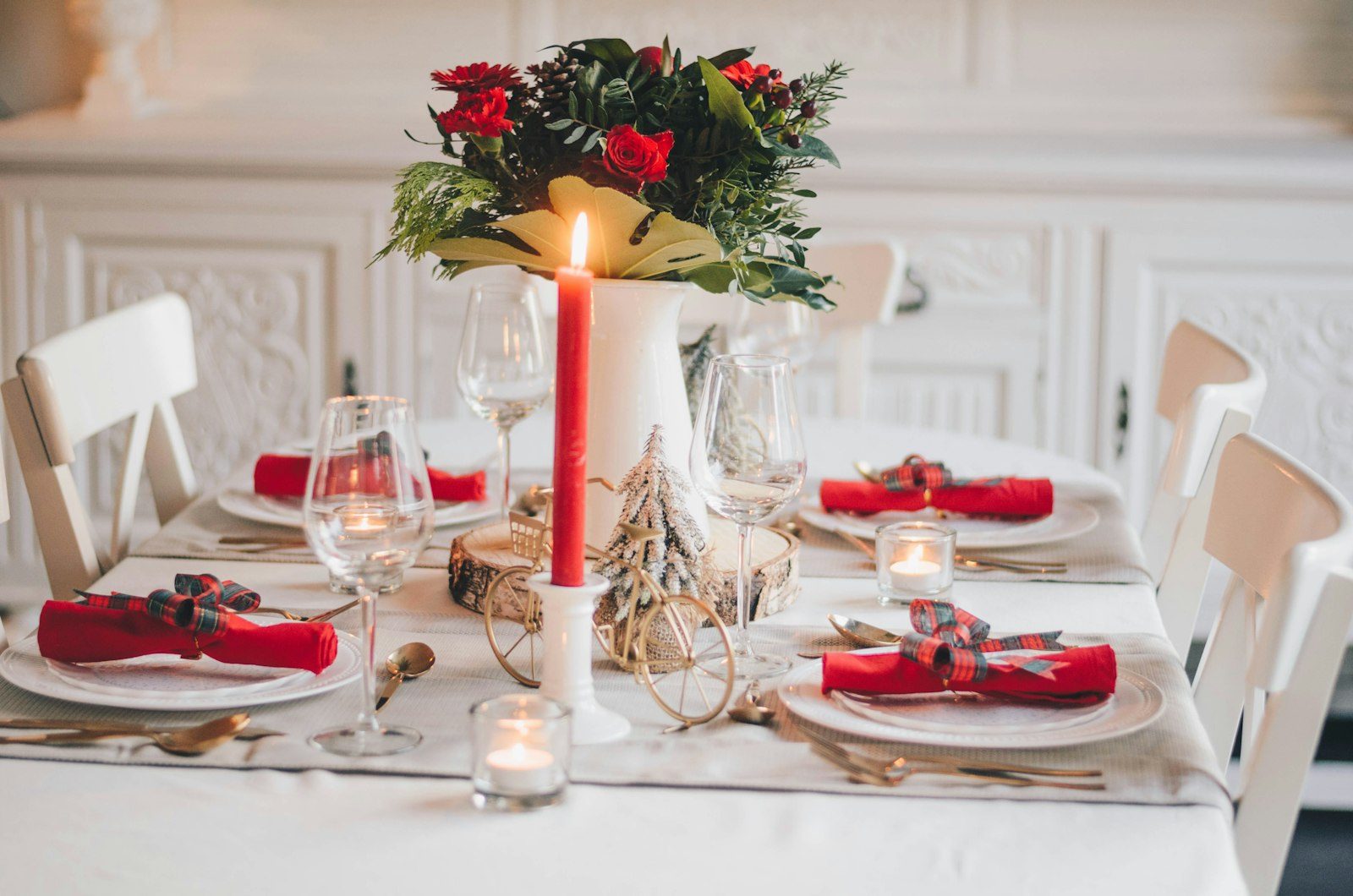
A single big centerpiece in the middle of the table has two problems: it blocks people’s view of each other, and there’s never anywhere to put the potatoes. Tables that look good at Christmas tend to be built up in thin layers instead. Each layer is simple, and none of them get in the way of eating.
The base
A runner, or two. A plain linen runner (on Amazon) down the length of the table, then either a narrower patterned runner (on Amazon) on top or two short runners crossing at each end. The overlap looks richer than one runner alone. A roll of kraft paper works as the bottom layer too: it’s about $10, kids can draw on it, and spills just mean tearing off a piece.
Or a different tablecloth. If your table always has a cloth on it, swapping it for deep green, cranberry or natural linen is the quickest change you can make. Get one that hangs about 6 inches over every edge, and avoid anything that needs ironing, because you won’t.
Candles down the middle
Instead of one centerpiece, line up candles along the center: tapers (on Amazon) in simple holders (on Amazon) with a few votives in between. On a 6-foot table, seven to nine candles is about right. Keep them in the middle third of the table so there’s room for plates and elbows.
Tapers look better in a few heights. You can cut standard 12-inch tapers down to 9 and 6 inches with a serrated knife and group them in threes. Dripless ones are worth the extra cost, and use holders with a proper cup.
My rule on real versus LED: real flames only while everyone’s sitting at the table and watching them. LED before and after. If there are kids at the table, make it all LED.
Small vases instead of one arrangement
Three to five bud vases (on Amazon), each with a single stem (a sprig of pine, one rose, a bit of eucalyptus), spaced loosely down the table. Nobody has to talk around them. They don’t need to match; same color, different shapes and heights.
One $6 bunch of grocery store eucalyptus or cedar covers all the vases, plus a sprig for each napkin. Buy it three or four days before the dinner so it has time to perk up in water.
The place settings
Name cards. Fold kraft cardstock (on Amazon) into small tents, write names in gold pen and tuck a sprig of pine behind each. It takes ten minutes and you settle the seating once, calmly, rather than at the table.
One napkin fold. Fold the napkin into a rectangle on the plate and tuck a pine sprig and a cinnamon stick under the top edge. Cloth napkins if you have them; solid paper ones are fine too. If the napkins are patterned, keep everything else plain.
Chargers. Gold (on Amazon), rattan or dark wood chargers under your everyday white plates make the table look formal without changing your dishes. They also protect the runner from hot plates. You’ll use them for Thanksgiving and every dinner party after.
The kids’ table
Give it its own small setup: a tray with a few shatterproof ornaments and an LED candle, and kraft paper with crayons as the runner. Everything on it should survive being knocked over, because it will be.
The sideboard
When the table fills up with food, move the tall or fragile things to the sideboard: the big vase, extra candles, the desserts. The room still feels decorated and the table stays usable.
In January, the runners, candleholders, vases and name card supplies all go in one box.