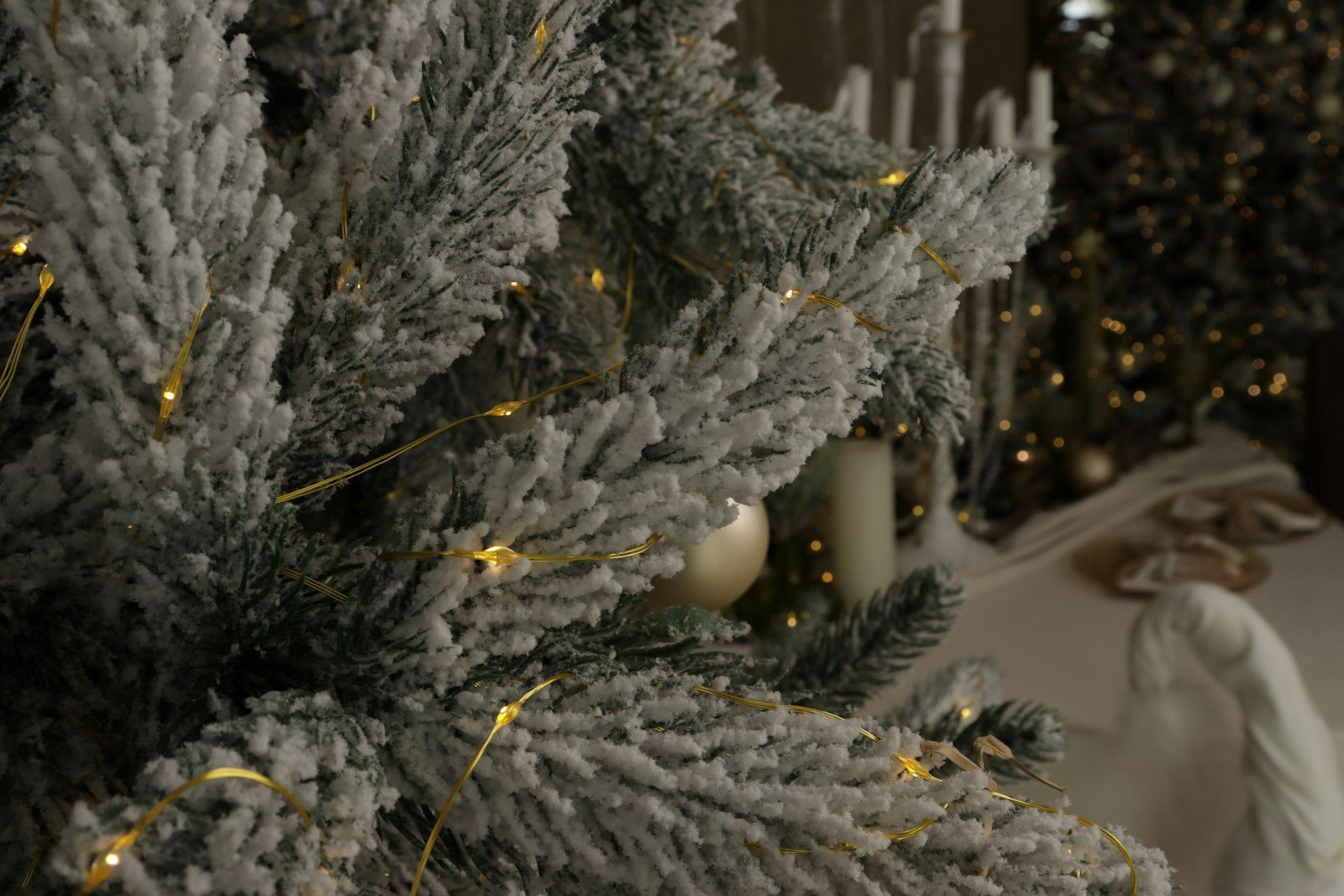
People tend to either love flocked trees or find them a bit much. They’re beautiful, they’re also messy, at least at first, and whether that trade is worth it depends on your home.
What flocking is
A sprayed-on coating, usually cellulose fibers and adhesive, sometimes with a little glitter, applied to an artificial tree to look like snow. It ranges from a light dusting on the tips to a heavy coat that hides nearly all the green.
Good flocking is even and sticks well, and it sits thicker on top of the branches than underneath, the way real snow does. Cheap flocking is patchy and clumpy and looks fake up close.
A flocked tree is already busy to look at, so it needs fewer ornaments than a green one. Metallics or jewel tones, lots of warm white lights, and restraint.
How much it sheds
The first year is the messy one. A new tree drops flocking every time it’s touched: putting it together, decorating, the cat walking past. Expect fine white dust on the floor around it all season, and on anything dark that brushes against it.
After that it settles down. Most of the loose flocking comes off in the first year. By the third, a decent tree sheds about as much as any artificial tree. The ones that keep shedding year after year are the cheap ones.
To keep the mess down: put it together outside or in the garage if you can and give it a shake before bringing it in. In the first year, put a washable rug under it, and run a handheld vacuum around the base once a week.
What it costs
For a 7.5-foot tree:
- $150 to $250. Lighter flocking, fewer branches, sometimes patchy. More first-year shedding, and it needs a lot of ornaments to look full.
- $250 to $400. The sensible range (example (on Amazon)). Better adhesion, fuller branches, often pre-lit.
- $400 to $600 and up. Heavy, even flocking and realistic branches. Past about $500 you’re mostly paying for the brand.
Pre-lit is worth it on a flocked tree. Wrapping your own lights through flocked branches knocks the flocking off and takes twice as long. Test every light before the tree goes up, because replacing a strand afterward is a project.
Who it suits, and who should think twice
It suits a winter cabin, glam or Scandinavian look, and it’s a fun choice somewhere that never sees snow.
Allergies. The flocking itself is generally considered hypoallergenic, but the fine dust in the first year can bother sensitive airways, and flocked branches hold onto household dust. If someone at home has asthma or dust allergies, a plain artificial tree is the safer choice.
Pets. A white tree shows every hair, and a dark cat that naps under it will leave plenty. Some dogs are fascinated by the texture, and you don’t want them eating the dust.
Small rooms. All that white makes a tree look bigger. In a studio, choose a slim flocked tree, not a full 7.5-foot one.
On the plus side, a flocked tree with lights and a dozen ornaments looks finished. A green tree needs about twice the decorations to look as complete.
Cleaning and storing it
During the season, a long-handled lint roller on the lower branches catches loose flocking in the first year. Later on, a hair dryer on cool and low blows off dust without disturbing the flocking. Never use a damp cloth; water and flocking turn into clumps.
Take ornaments off gently rather than pulling them through the branches, or over the years the flocking wears thin in those spots.
Keep the original box. Flocking doesn’t compress, and forcing the tree into a smaller bag crushes it into flat patches. If the box is gone, use an upright tree storage bag (on Amazon). Store it somewhere dry; damp storage leaves you with a tree that smells like a basement.
A good flocked tree lasts 7 to 10 years. A cheap one starts to look patchy after 3 or 4, so buying mid-range once usually works out cheaper than budget twice.