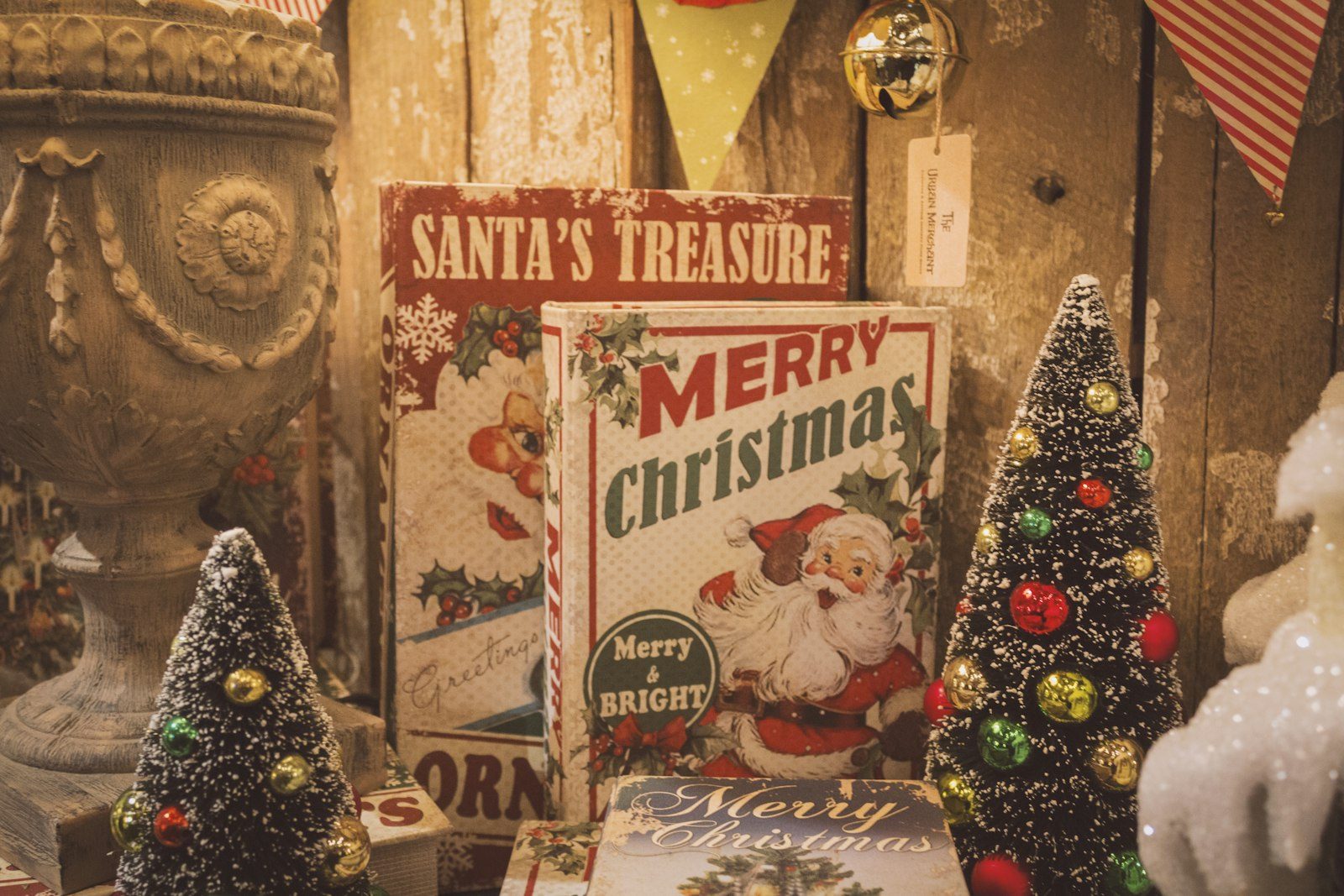
Thrift stores in October and November have a lot of old Christmas decorations, and plenty of the good ones get passed over as dusty boxes. Old pieces have something new decorations can’t quite copy: real wear, real weight, a slightly imperfect hand-painted face.
What’s worth looking for
Shiny Brite ornaments. American glass ornaments made from the 1940s to the 1960s, with silvered insides, painted designs and cardboard caps stamped “Shiny Brite.” Look for silvering without dark patches inside, original paint and caps that aren’t bent. A box of 12 in good shape for under $15 is a real find. Partial boxes are worth it too; mix them with plain new balls in matching colors, or new vintage-style ones (on Amazon).
Bottle-brush trees. The fuzzy little trees, made from the 1940s to the 1970s in green, white, pink and some surprising brights, sometimes flocked. Old ones are denser than new reproductions. Give one a gentle shake: a little shedding is normal, bald patches aren’t. The 6 to 12-inch size is the most useful. If you can’t find old ones, new bottle-brush trees (on Amazon) are a fine stand-in.
Ceramic light-up trees. Green or white with little plastic lights in the branches, mostly from the 1970s and 80s. Plug it in at the store if you can; there’s usually an outlet near the lamps. Check for the base, the star and as many of the little lights as possible, since replacements cost more than you’d expect. Fine hairline cracks are common and usually stable; chips on the edges aren’t. A new light-up ceramic tree (on Amazon) is the fallback if you can’t find an old one.
Mercury glass. Silvered on the inside, with a mottled, slightly uneven mirror finish. Hold it up to the light: real mercury glass has small imperfections, while new “mercury look” glass is evenly sprayed. You’ll find ornaments, candle holders, vases and bead garlands, often priced like ordinary decor.
Aluminum trees. The silver tree from A Charlie Brown Christmas. Original 1960s trees with all their branches can be worth $100 or more. Count the branches (most had 40 to 80), check for bent or missing foil, and look for the rotating color wheel light. Without the wheel, it’s worth about half.
Ceramic Santas and mugs. From the 1950s to the 1980s, often cheap. Look at the mark on the bottom for the era. Keep old mugs for display rather than cocoa unless you know the glaze is food-safe. Chalkware figures are fragile; look for patches of paint that don’t quite match, which usually mean a repair.
Is it actually old?
- The mark on the bottom. “Made in Japan” often means before the 1970s, “Hong Kong” the 70s and 80s, “Taiwan” the 80s and 90s. Maker names like Shiny Brite, Atlantic Mold or Holt Howard help too. A quick search on your phone settles most questions.
- The weight. Old glass ornaments are lighter and thinner than new ones. Old ceramics feel denser. Reproduction bottle-brush trees feel thin and plasticky.
- The wear. Real age shows unevenly: fine crazing in the glaze, paint worn on the high points, slightly yellowed plastic. Fake distressing looks the same on every piece.
- Known reproductions. Shiny Brite, bottle-brush trees and ceramic trees are all reproduced now. They’re fine to buy, just not at vintage prices. Check what the new one costs before paying $60 for an “old” one.
Cleaning without damage
Glass ornaments: lukewarm water, a drop of mild soap, a soft cloth. Don’t soak them; water gets under loose caps and ruins the silvering. Dry right away.
Bottle-brush trees: don’t wash them. Water mats the bristles and dissolves old glue. Use a soft dry brush or a hair dryer on cool. If one smells musty, leave it outside in the air for a day.
Ceramics: damp cloth, mild soap, dry well. Check the cord and wiring on anything that lights up before plugging it in, and replace a frayed cord.
No bleach, harsh cleaners, dishwasher or ultrasonic cleaner. When in doubt, just dust it. The wear is part of what you’re paying for.
Mixing old and new
Use vintage pieces as accents rather than filling a room with them. Roughly 70 percent new or neutral, 30 percent vintage: a modern tree with a cluster of Shiny Brites, a plain garland with old bottle-brush trees tucked in.
Group them. One old Santa on a shelf looks random; three together look collected.
Match colors rather than decades. A pink 1960s bottle-brush tree fits right into a blush and gold scheme. If the colors work, the eras take care of themselves.